OPEN SOURCE · CLAUDE CODE · MIT

A model for every step. A stop for every run.

lake-meter suggests the right model for each step of your plan, and stops the run when it reaches the budget you set. Before the limit is gone.

A run budget for Claude Code that stops and asks.

Set a budget for each run. When Claude Code reaches it, the next tool call asks you before it spends more. Every step of your plan also gets a recommended model. Before the limit is gone.

$ npx lake-meter init
Read the README on GitHub

One command. Local only. No account, no telemetry.
Uses Claude Code's own hooks, statusline and plan dialog.

Ready to code? · plan modeestimate
LAKE METER

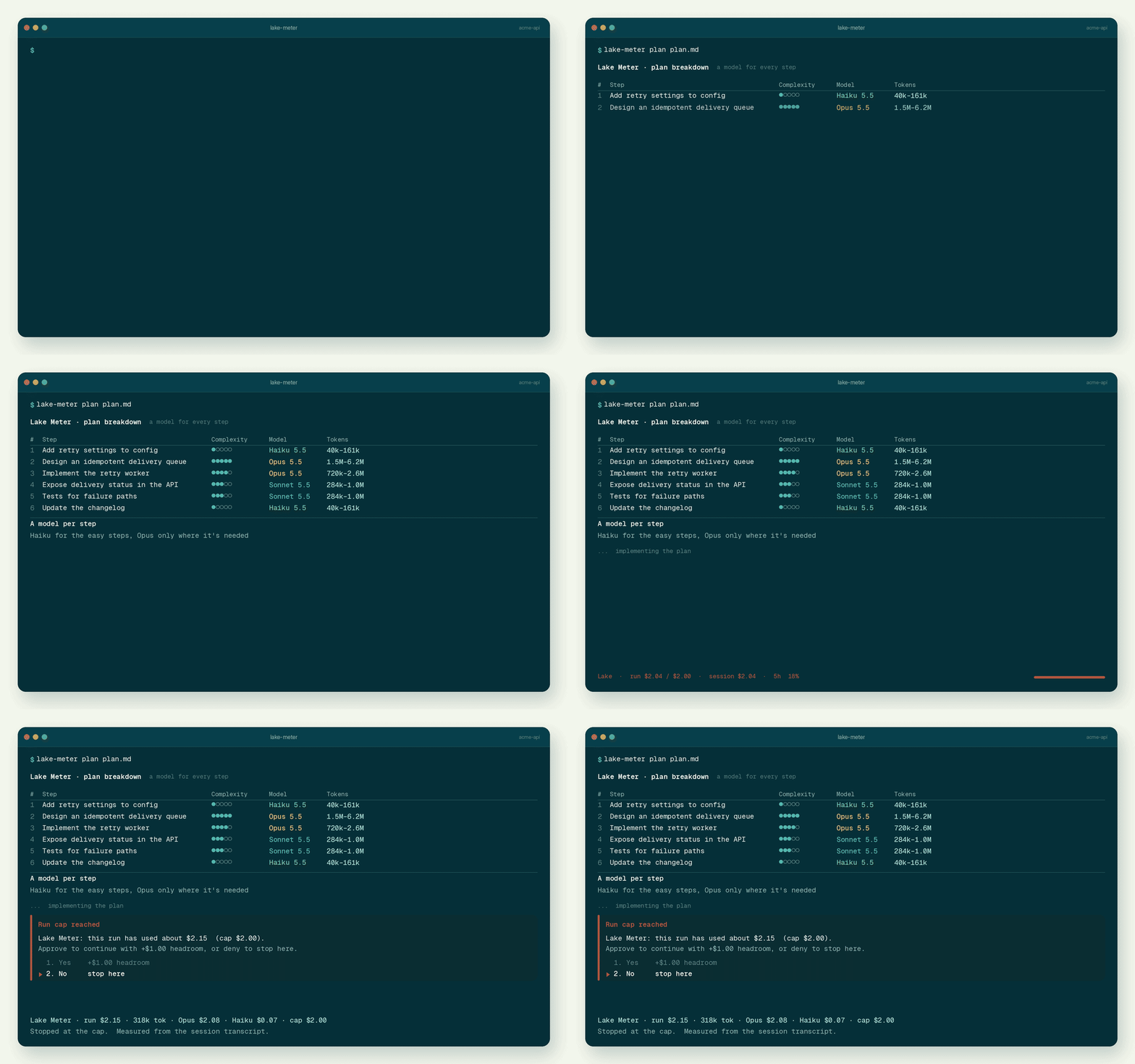
A model per stepHaiku for the easy steps, Opus only where it's needed

  1. 01Add retry settings to configHaiku40k–161k
  2. 02Idempotent delivery queueOpus1.5M–6.2M
  3. 03Retry worker with backoffOpus720k–2.6M
  4. 04Delivery status endpointSonnet284k–1.0M
  5. 05Failure-path testsSonnet284k–1.0M
  6. 06Changelog entryHaiku40k–161k
Run cap reached$2.15 of $2.00 · before the next tool call
Yes · +$1.00 headroomNo · stop here
RECEIPT · MEASURED

$3.44 · 524k tok · Opus $3.44

measured from the session transcript
lake-meter demo: a plan split into steps with model picks, then a run stopped at the cap

The limit is gone at 11am.

A loop ran all night.

Opus wrote the changelog.

Six subagents, one bill.

THREE MOMENTS

Before, during, and after
every run.

01

Plan: a model per step

When Claude writes a plan, lake-meter rates each step 1 to 5, picks the cheapest model that should handle it, and adds a token range for each step. It shows up inside Claude Code's own plan dialog.

Two subagents, pinned to Haiku and Sonnet, make the advice one delegation away (skip them with --no-agents).

02

Run: a cap that asks

Set a budget per run in dollars, tokens, or a share of your 5-hour window. When a run reaches it, the next tool call becomes a permission prompt. Yes adds headroom. No stops Claude right there. Unattended runs end the turn instead.

Adjust anytime with /meter cap 10.

03

After: a measured receipt

When Claude stops, you get the run's real token count and its list-price cost, split by model and subagents. Your history stays in a local file for npx lake-meter report.

Plus a live meter in the statusline.

HONEST NUMBERS

We tell you what's measured
and what's a guess.

NumberSourceStatus
Tokens per runClaude Code's session and subagent transcripts, de-duplicated per responseMeasured
Dollars per runMeasured tokens × list prices in one editable file, per request. Matched Claude Code's own cost figure in our testsComputed
5-hour windowThe percentage Claude Code reports to the statusline on Pro and MaxReported
Plan breakdownKeyword and size heuristics plus token budgets you can tune. Every reason is shown with --whyEstimate

Dollar figures are API list-price equivalents, verified 12 Nov 2026. On a subscription they measure how heavy a run was, not what you were charged. The cap is checked before each tool call, so a single long response can pass it.

NO MAGIC

Built on what Claude Code already exposes.

Four hooks, a statusline, a skill and two subagents. npx lake-meter uninstall restores your settings exactly. Nothing leaves your machine.

FOR TEAMS

Running Claude Code across a team?

  • Works with lake-gate: a teammate approves the plan before the expensive run
  • Early access: shared caps and a dashboard of runs by repo and model. We're talking to a few teams.